
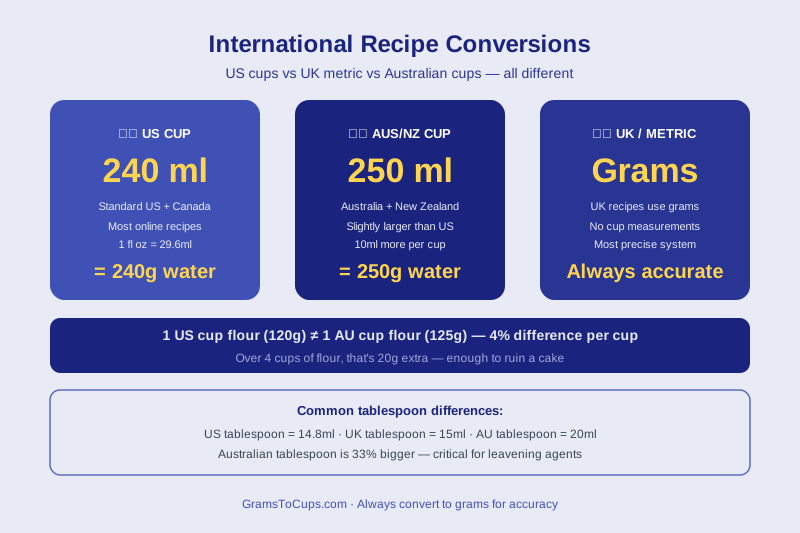
One of the most overlooked sources of baking failure is the simple fact that a "cup" is not a universal measurement. A US cup, an Australian cup, a Canadian cup, a UK imperial cup and a Japanese cup all have different volumes — and when you're following an online recipe from a different country, using the wrong volume for your "cup" can mean adding significantly too much or too little of a key ingredient. For the most critical ingredients — flour, sugar and leavening agents — these differences can ruin a recipe entirely.
Cup Sizes by Country
| Country / Region | Cup Volume (ml) | 1 Cup Water Weight (g) | Notes |
|---|---|---|---|
| United States | 240ml | 240g | Most online English recipes |
| Canada | 250ml | 250g | Often interchangeable with US in recipes |
| Australia / New Zealand | 250ml | 250g | 10ml larger than US |
| UK (metric) | 284ml (1 imperial cup, rarely used) | 284g | UK recipes almost always use grams, not cups |
| Japan | 200ml | 200g | Japanese recipes use smaller cups |
Tablespoon Sizes: The Biggest Difference
The tablespoon difference between countries is even more impactful than the cup difference — because tablespoons are used to measure potent ingredients like baking powder, baking soda and spices:
| Country | Tablespoon (ml) | vs US Tablespoon |
|---|---|---|
| United States | 14.8ml (~15ml) | Reference |
| United Kingdom | 15ml | +0.2ml (negligible) |
| Australia | 20ml | +33% larger (significant!) |
| New Zealand | 15ml | Same as UK |
| Canada | 15ml | Same as UK |
The Australian tablespoon being 33% larger than the US tablespoon is one of the most consequential international measurement differences in baking. If you follow an Australian recipe calling for 1 tablespoon of baking powder (20ml) and use a US tablespoon (15ml), you're adding 25% less leavening — your baked goods won't rise as well. In reverse: using an Australian tablespoon with a US leavening recipe adds 33% too much baking powder, which can cause a cake to over-rise and collapse.
Impact on Common Ingredients
| Ingredient | US: 1 cup | AU: 1 cup | Difference |
|---|---|---|---|
| All-purpose flour | 120g | 125g | +5g per cup |
| White granulated sugar | 200g | 208g | +8g per cup |
| Butter | 227g | 236g | +9g per cup |
| Water / milk | 240g | 250g | +10g per cup |
| Baking powder (1 tbsp) | 12g (US) | 16g (AU) | +33% (critical!) |
| Cocoa powder | 85g | 89g | +4g per cup |
The easiest solution to all international measurement confusion: convert everything to grams. Weight is universal — 120g of flour is 120g of flour regardless of whether the recipe is American, Australian or British. Use our tablespoon to grams guide to convert any recipe to weight-based measurements.
UK Recipes: Grams and Imperial
UK recipes post-2000 almost universally use grams and millilitres, not cups. Older UK recipes (pre-1970) use imperial measurements: ounces, pounds, pints and fluid ounces. Key UK conversions:
- 1 UK fluid ounce = 28.4ml (US fluid ounce = 29.6ml)
- 1 UK pint = 568ml (US pint = 473ml) — US pint is significantly smaller
- 1 UK ounce (weight) = 28.35g — same as US ounce
- 1 UK pound = 453.6g — same as US pound
Frequently Asked Questions
How much bigger is an Australian cup than a US cup?
An Australian cup holds 250ml, while a US cup holds 240ml — a difference of 10ml, or about 4% larger. For water and most liquids, 1 Australian cup = 250g vs 1 US cup = 240g. Over 4 cups of flour (a common large cake recipe), this adds approximately 20g of extra flour — enough to noticeably affect the texture of a cake. For critical ingredients, always weigh rather than relying on cup measurements.
Why does Australia use a bigger tablespoon?
Australia historically used the British imperial tablespoon of approximately 18ml, which over time was rounded up to a convenient 20ml metric tablespoon when Australia metricated in the 1970s. The US tablespoon is based on a different historical measurement system (1/16 of a US cup = 15ml). There is no single "correct" tablespoon — different systems simply evolved independently. Modern Australian recipe websites often note "Australian tablespoon = 20ml" precisely because international readers are frequently confused.
How do I know which country a recipe is from?
Key indicators: (1) Flour spelled as "plain flour" → UK, Australia or New Zealand (US uses "all-purpose flour"); (2) "Bicarbonate of soda" → UK/AU (US uses "baking soda"); (3) "Caster sugar" → UK/AU (US uses "superfine sugar" or just "sugar"); (4) "Cornflour" → UK/AU means cornstarch; (5) Temperatures in °F → almost always US; (6) All weights in grams → almost always UK or European; (7) Cups used alongside grams → often Australian.
How do I convert a US recipe for Australian measurements?
The simplest approach: use weight (grams) for everything and ignore cup sizes entirely. Use our gram weights charts to convert: flour 1 US cup = 120g; sugar 1 US cup = 200g; butter 1 US cup = 227g; milk 1 US cup = 240g. For tablespoon-measured ingredients (baking powder, spices), if following a US recipe with Australian tablespoons: use ¾ of the Australian tablespoon volume (= 15ml = 1 US tablespoon), or convert to grams using our tablespoon weight chart.
Do British recipes ever use cups?
Very rarely. Modern UK recipes use grams and millilitres almost exclusively. Some very old British recipes use fluid ounces and ounces (weight). A small number of UK food blogs aimed at international audiences include cup measurements, but these are the exception. When a UK recipe does use cups, it's typically using 250ml cups (British metric standard). If you see a UK recipe with cups and it doesn't specify the cup size, assume 250ml — the metric standard.
Is a "metric cup" the same everywhere?
No — "metric cup" means different things. In Australia and Canada, a metric cup is 250ml. In some European contexts, a "cup" measure is 200ml (a coffee cup size). Japan uses 200ml. There is no international standard for "cup" — it is a historical measurement that varies by country and era. Only the metre, kilogram and litre are internationally standardised. This is the strongest argument for always using grams and millilitres in baking.