
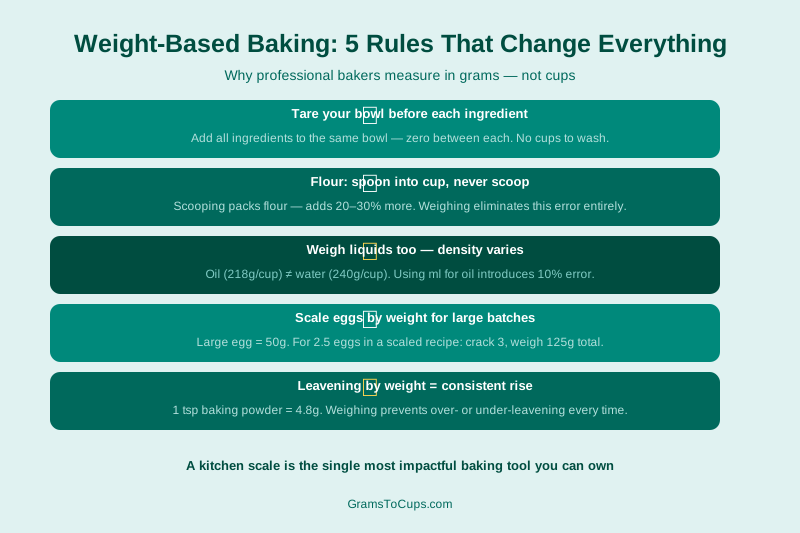
Every professional baker — from pastry chefs at Michelin-starred restaurants to industrial bread factories — measures in grams. Home bakers who switch from cup-based to weight-based measurement consistently report more reliable results, fewer failures and better understanding of what they're actually doing in the kitchen. This guide explains precisely why gram-based baking is superior and how to make the transition seamlessly.
The Fundamental Problem with Cup Measurements
The core issue with cups is that they measure volume, not mass. And the density of different ingredients — and even the same ingredient measured different ways — varies enormously:
- 1 cup of all-purpose flour, scooped directly: 150–175g
- 1 cup of all-purpose flour, spooned into cup and levelled: 120–130g
- 1 cup of all-purpose flour, sifted then spooned: 100–110g
That's a range of 100g to 175g — a difference of 75% — for what a recipe calls "1 cup of flour." In a recipe calling for 3 cups of flour, that variation means the difference between adding 300g and 525g of flour. No wonder so many home bakers get inconsistent results.
5 Reasons to Switch to Gram-Based Baking
1. Elimination of Measurement Technique Error
When you weigh 120g of flour, you have exactly 120g every time — regardless of how densely packed the flour is, how humid the kitchen is or which cup you're using. The same measure, every time, with zero technique variation. This is particularly important for flour (which packs dramatically differently based on how recently it was sifted or aerated) and for dense ingredients like brown sugar, almond flour and desiccated coconut.
2. Fewer Dishes to Wash
With a kitchen scale, you can measure every ingredient directly into the mixing bowl, zeroing (taring) between each addition. A typical cake recipe — flour, sugar, butter, milk, eggs — can be prepared in a single bowl with zero measuring cups or spoons to wash. This saves significant time and is one of the most immediately practical benefits of weight baking.
3. Easier Recipe Scaling
Scaling a recipe from 12 muffins to 18 muffins requires multiplying all ingredients by 1.5. With weight: 120g flour × 1.5 = 180g. With cups: "1.5 cups" is easy, but "1.5 teaspoons" of baking powder requires converting to tablespoons, and "1.5 eggs" requires weighing anyway. Weight-based scaling is mathematically clean and works perfectly even for fractional recipes. See our recipe scaling tips guide.
4. Accurate Leavening
Baking powder and baking soda are the ingredients where measurement precision matters most — a small error in these makes your baked goods not rise, collapse or taste metallic. 1 teaspoon of baking powder weighs 4.8g. A slightly heaped teaspoon might weigh 6g — 25% more. At scale, these errors compound. Weighing your leavening agents gives you precise control over your recipe's rise. See our leavening ratios guide.
5. International Recipe Compatibility
As discussed in our international recipe conversions guide, a US cup (240ml) and an Australian cup (250ml) produce different results. An Australian tablespoon (20ml) is 33% larger than a US tablespoon (15ml). When you bake by weight in grams, international recipes work perfectly without any conversion — 120g of flour is 120g everywhere in the world.
How to Transition to Weight-Based Baking
Getting started requires only one tool: a digital kitchen scale. Look for one that:
- Measures in 1g increments (some cheaper scales only do 5g, which is not precise enough for small amounts of leavening)
- Has a tare/zero function (essential for bowl baking)
- Has a capacity of at least 3kg (enough for bread dough batches)
- Has a stable flat surface and easy-to-read display
Your first purchase on this site is the recipe gram weights database — we've done the work of standardising every major baking ingredient's cup to gram conversion. Use our main conversion tool to convert any recipe from cups to grams before baking, then save the gram version for next time.
Frequently Asked Questions
How much does 1 cup of flour actually weigh?
One cup of all-purpose flour weighs 120 grams when spooned into the cup and levelled — this is the measurement convention used by most professional recipe developers and on our site. However, if you scoop the cup directly into the flour bag, you can easily pack 150–175g into the same cup. The difference between these two techniques is enormous — up to 46% more flour in the scooped version. This is why weighing flour is so important.
Do I need an expensive scale for baking?
No — a basic digital kitchen scale costing £10–25 / $12–30 is entirely sufficient for home baking. Look for 1g resolution and a tare function. More expensive scales offer features like a pull-out display (for large bowls), faster response times and water resistance. For bread baking and sourdough, a 0.1g scale (often called a "jewellery scale") is useful for weighing precise amounts of yeast or salt. But for the vast majority of home baking, any basic digital scale with 1g resolution is perfect.
What is the tare function on a kitchen scale?
The tare function resets the scale to zero while the bowl or container is on it. Place your bowl on the scale → press tare → scale reads 0g despite the bowl's weight → add first ingredient until you reach the target weight → press tare again → add second ingredient → and so on. You can measure every ingredient in the same bowl without removing it from the scale. This is the core technique that makes weight-based baking faster and less messy than cup-based baking.
How do I convert my favourite cup-based recipe to grams?
Use our ingredient weight charts on this site — each page gives the gram equivalent for every cup, tablespoon and teaspoon amount. Work through the recipe ingredient by ingredient, converting each to grams. Write the gram amounts next to each ingredient in the recipe (or make a separate gram-based copy). After making the recipe once with gram measurements, you'll have a perfectly calibrated version you can rely on every time. The most important ingredients to convert precisely: flour, sugar, butter and leavening agents.
Can I still use cup measurements occasionally?
Yes — for some ingredients, cups are perfectly adequate. Liquids (water, milk, juice) are measured accurately by volume, and a tablespoon of vanilla extract doesn't need gram-level precision. The ingredients where gram precision matters most are: flour, sugar, butter, nut flours and leavening agents (baking powder, baking soda, yeast). For everything else, cups and tablespoons work fine. Many experienced bakers weigh precise ingredients and use cups for less critical ones — a perfectly sensible hybrid approach.
Is weight-based baking better for bread making?
Absolutely — in bread making, gram precision is essential. Bread hydration (water weight as a percentage of flour weight) determines everything: whether the dough is workable, how open the crumb is, how the crust behaves. A difference of 10g of water in a 500g flour recipe is a 2% hydration change — and a 2% hydration difference can be the boundary between a stiff, unworkable dough and a perfectly extensible one. Professional bread recipes always specify everything in grams with baker's percentages. Start baking bread by weight and you'll never go back to cups.